West Suburban Chicago Neighborhoods: The Full Guide
September 23, 2026
September 23, 2026
Picture this: you've just accepted a position downtown, or your company is relocating your family to the
Chicago area, and someone tells you to look in the west suburban Chicago neighborhoods. That phrase
sounds simple until you pull up a map and realize you're staring at a corridor of a dozen distinct
communities, each with its own character, price range, and relationship with the Metra schedule. The
western suburbs of Chicago are not interchangeable, and choosing the wrong one is an expensive
mistake.
This guide gives you a practical framework for narrowing that corridor down to three or four communities
worth visiting in person. It draws on years of on-the-ground experience helping buyers find the right fit
across DuPage County and the broader Chicago metro, covering the four factors that drive nearly every
west-suburban buying decision: commute time, school district quality, median home price, and lifestyle
feel. Work through each section and you'll finish with a real shortlist, not just a longer version of the same
confusion you started with.
What to know before you pick a suburb
The four factors that drive west suburban Chicago neighborhoods
buying decisions
Commute time, school district rating, median home price, and walkability interact differently depending on
your household profile. A dual-income couple without children often weighs commute and lifestyle first,
treating school ratings as background noise. A family relocating from out of state typically flips that
priority entirely, accepting a longer commute in exchange for a top-rated district. Neither approach is
wrong. Your profile determines which factor is the ceiling and which ones are negotiable.
This guide organizes communities roughly by commute distance from the Loop, which naturally
correlates with price and density. But lifestyle factors frequently override geography. Some buyers
discover they'd rather pay more for a shorter commute; others realize they care far less about commute
time than they expected once they're touring neighborhoods and feeling the difference in character
between a village-center suburb and a more car-dependent outer community.
Why "the western suburbs" covers more ground than buyers expect
The suburbs west of Chicago span a broad corridor, Oak Park to Naperville covers well over 25 miles by
most mapping estimates, and an enormous range of real estate values. For orientation purposes, think in
three rings: inner (Oak Park, La Grange, Elmhurst), mid-distance (Downers Grove, Glen Ellyn, Wheaton,
Lombard), and outer (Naperville, Lisle, Woodridge, Westmont). Price and commute time generally rise as
you move outward, though there are exceptions at each tier.
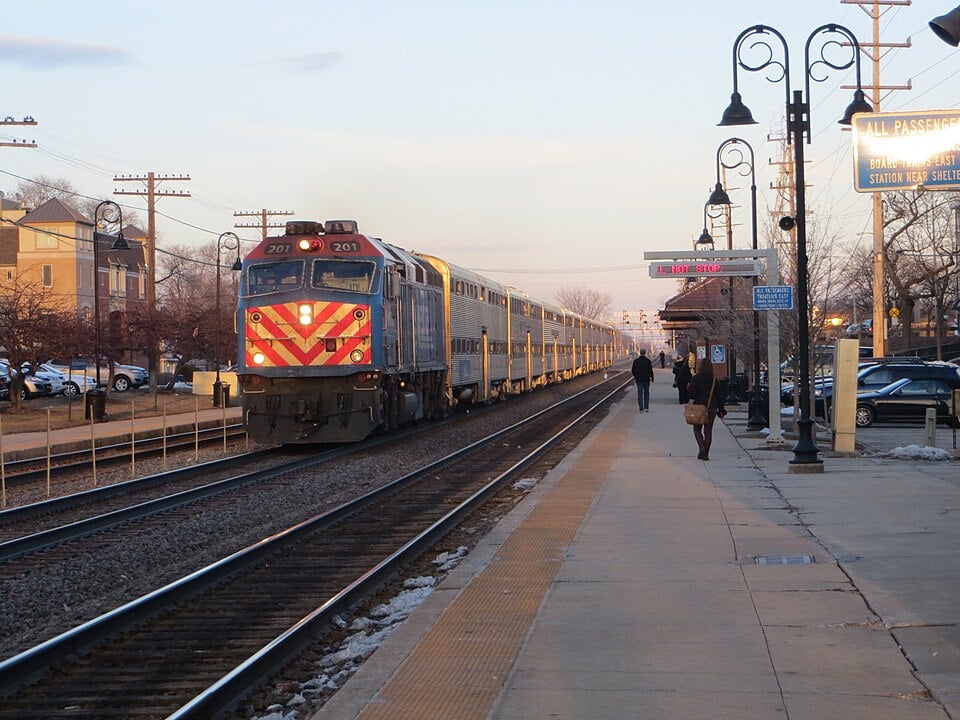
Metra access is one of the most significant quality-of-life factors for Loop commuters across these
Chicago west suburbs. The two primary lines are Metra BNSF to Union Station and Metra Union Pacific
West to Ogilvie Transportation Center. Which line serves your suburb determines not just your commute
time but your downtown destination and your connection options. Every community profile below notes
the line and the typical ride time so you can compare apples to apples.
West suburban Chicago neighborhoods: near-west options with
fast commutes
La Grange and Hinsdale: 20 to 38 minutes to the Loop
La Grange sits on the BNSF Metra line with two stations, delivering a 20-to-30-minute ride to Union
Station, one of the shortest commute windows in the entire western corridor. The village has a compact,
walkable downtown centered on the train stations, with independent restaurants, local shops, and a
community identity that feels rooted rather than assembled for marketing purposes. For buyers who want
close-in suburban living without urban density, La Grange is consistently one of the most underrated
options in this market.
Hinsdale adds 8 to 10 minutes to that commute but steps up significantly in price and prestige, with a
2026 median sale price around $1.45, 1.5M (per local MLS and county-recorded sales data). Hinsdale
Township High School District 86 ranks among the top five in the Chicago metro, per Niche's most recent
Illinois district rankings, and earns an A+ on the Illinois Report Card. The downtown is manicured and
upscale, and the housing stock reflects the price point. Buyers comparing La Grange and Hinsdale are
usually making a straightforward trade-off: La Grange offers excellent commute value and walkability at
an accessible price, while Hinsdale delivers elite school access and prestige-community positioning at a
significant premium.
Elmhurst and Oak Park: urban texture with suburban calm
Elmhurst uses the Metra Union Pacific West line to Ogilvie Transportation Center, typically a 26-to-39-
minute ride depending on the train, based on published Metra timetables. The downtown is polished and
walkable, with a strong restaurant scene and a community feel that draws buyers who want suburban
safety without suburban sterility. The 2026 median sale price for detached single-family homes sits
around $685, 755K, placing Elmhurst near the top of the UP-West inner-ring suburbs by price (per local
MLS data).
Oak Park is the most urban of the western suburbs in this corridor, with architectural significance (Frank
Lloyd Wright homes throughout), genuine cultural diversity, and commute times that rival La Grange on
the Green and Pink CTA lines. Buyers choosing between Oak Park and Elmhurst are typically weighing Oak
Park's density and energy against Elmhurst's quieter, more traditional suburban character. Both are strong
choices; the right answer depends entirely on how much urban texture you actually want in your daily
environment.
Mid-distance communities for families and schools
Downers Grove: the two-Metra-line advantage
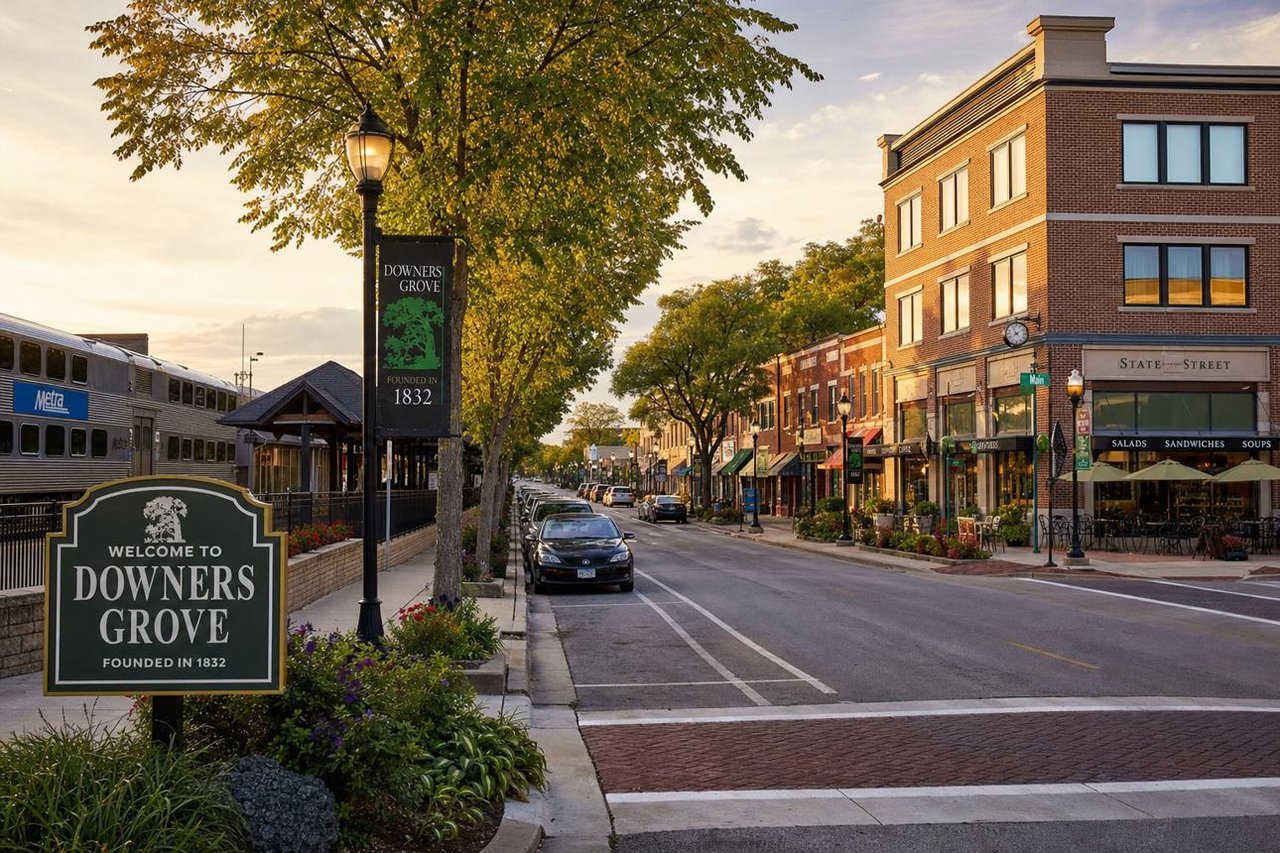
Downers Grove is one of the few suburbs in the western corridor served by two Metra lines, giving
commuters flexibility that single-station towns simply can't offer. The 2026 median sale price for
detached single-family homes sits around $550, 580K, making it one of the more accessible mid-distance
options for move-up buyers (per local MLS data). The housing stock is diverse: 1950s ranches, Victorian-
era homes near the downtown, and newer construction farther out from the train.
Both of Downers Grove's downtown districts have restaurants, coffee shops, and year-round community
events that create a real neighborhood feel. The nuances here matter more than the averages, school
assignment zones and price trends shift meaningfully from block to block. The Wardlow Group publishes
detailed neighborhood guides and market snapshots for Downers Grove that go well beyond median
prices, which is worth bookmarking if this community lands on your shortlist.
Glen Ellyn and Wheaton: school ratings that move buyers
Glen Ellyn and Wheaton consistently rank among the strongest school communities in the Chicago
metro's western corridor. Community High School District 128 earns an A+ on the Illinois Report Card and
ranks #4 in the Chicago area per Niche's district rankings. For families relocating from another state, that
kind of verified district quality is often the deciding factor that brings them to this part of DuPage County
in the first place.
Wheaton adds Wheaton College as a cultural anchor and has a strong parks system that makes it
particularly appealing for families with young children. Glen Ellyn has a more intimate village-center feel,
with historic homes near the train station and an unhurried pace that sets it apart from more commercial
suburban corridors. Both use the Metra Union Pacific West line, with commutes running 40 to 55 minutes
to Ogilvie (per published Metra schedules). Median prices in Wheaton ranged from $565, 625K in 2026,
making these two communities a competitive but realistic target for buyers willing to trade a longer
commute for school quality.
Naperville and the outer-ring suburbs: space, amenities, and
trade-offs
Naperville: the largest market in the western corridor
Naperville is the most recognized name in Illinois suburban real estate, and the reputation holds up on
examination. The downtown Riverwalk area is one of the best-developed suburban commercial districts in
the Midwest. Two top-rated school districts serve the community: Indian Prairie CUSD 204 (A+, ranked #8
in the Chicago metro per Niche) and Naperville CUSD 203 (A+, ranked #10 per the same source). The
2026 median sale price for detached single-family homes sits around $700, 749K per local MLS data.
The trade-off is commute time. Metra BNSF riders typically spend 50 to 60 minutes reaching Union
Station based on published timetables, which is a dealbreaker for some buyers and a reasonable
exchange for others. Naperville makes the most sense for buyers who work from home part of the week,
have flexible office schedules, or work in the western suburbs rather than downtown. For daily Loop
commuters who are rigid about commute time, the math rarely works in Naperville's favor no matter how
strong the schools are.
Lisle, Westmont, Lombard, and Woodridge: the underrated middle tier
These four communities get skipped in too many conversations about west suburban Chicago
neighborhoods, and each serves a real buyer profile worth considering. Lisle sits on the BNSF corridor
near Downers Grove, with lower entry prices and strong highway access that makes it practical for buyers
who split time between downtown and western-suburb offices. Westmont offers BNSF Metra access with
a roughly 35-minute commute and housing prices that remain accessible for first-time buyers entering the
detached single-family market.
Lombard uses the Union Pacific West line with a 35-to-40-minute commute to Ogilvie and broad housing
variety that works for buyers at several price points. Woodridge leans quieter, with forest preserve access,
bike paths, and easy I-355 access, more lifestyle-driven than transit-driven, which makes it a better fit for
remote workers or buyers whose jobs are west of the city. All four offer meaningful price relief compared
to Naperville or Hinsdale without sacrificing the essential suburban amenities most buyers require.
Home prices across the western suburbs in 2026
What the price tiers actually look like
The 2026 market breaks into three recognizable tiers based on observed median sales across these
communities (sourced from local MLS data). The entry tier runs roughly $500, 620K and includes
Downers Grove, Wheaton, Lisle, Westmont, and parts of Lombard and Woodridge. These are communities
where buyers still find detached single-family homes on established lots without stretching into a luxury
budget, typically three-to-four-bedroom homes with older but well-maintained finishes and mature
landscaping.
The mid-market tier sits from $650K to $800K and covers Naperville, Elmhurst, and Glen Ellyn, where
school quality and lifestyle amenities justify the higher price point. Newer construction becomes more
available at this tier, home sizes grow, and lot sizes in some communities allow for more usable outdoor
space. The luxury tier starts at $1M and up, anchored by Hinsdale ($1.45, 1.5M median) and Oak Brook
($1.0, 1.5M median), where buyers are purchasing architectural character, premium school access, and
prestige-community positioning alongside the home itself.
Building your shortlist and planning your visits
A practical shortlisting framework for west suburban Chicago
neighborhoods
Start with commute tolerance. If a 45-minute Metra ride is your ceiling, your map shrinks immediately to
the near-west and mid-distance communities. Apply school priority next: if district rating is non-
negotiable, Glen Ellyn, Wheaton, Hinsdale, and Naperville move to the top of your list. Finally, run the price
filter: if your budget is under $650K, Hinsdale and Oak Brook come off the list entirely, and Naperville
becomes a stretch rather than a default. What typically remains after filtering for all three factors is a
shortlist of two to four communities that are realistic and well-matched to your actual life.
The communities that survive your filter are the ones worth visiting in person, ideally on a weekday
morning so you can experience the commute conditions rather than just read about them. Walk the
downtown. Drive the residential blocks near the train. Sit in a coffee shop for 20 minutes and pay
attention to who's there and whether the neighborhood feels like the right version of suburban life for your
household. No amount of data replaces that ground-level sense.
Using local neighborhood guides and market data to go deeper
Once you have a working shortlist, the next step is neighborhood-level research rather than suburb-level
research. Median prices and district ratings tell you whether a community is worth considering; block-by-
block market data tells you whether a specific street fits your budget and lifestyle. The Wardlow Group
publishes detailed neighborhood guides and local market snapshots for DuPage County communities
including Downers Grove, Darien, Lisle, Westmont, and several neighboring suburbs. These resources go
beyond headline numbers to cover school assignment zones, recent sales activity, and local amenity
clusters that don't show up in aggregate data.
Connecting with a hyperlocal team before your visit tours can save weeks of trial and error. The right
questions to ask while standing in a driveway are different from the questions you ask when browsing
listings online, and an agent who works these communities daily knows which blocks to steer toward, and
which ones to explain honestly before you fall in love with a house on a street that doesn't fit your
priorities.
The right suburb is the one that fits your life
Choosing among west suburban Chicago neighborhoods is not about finding the objectively best
community. It's about matching the right suburb to your commute threshold, school priorities, budget, and
lifestyle expectations. Near-west communities like La Grange, Hinsdale, Elmhurst, and Oak Park serve
commuters who prioritize fast Metra access and walkable downtowns. Mid-distance options including
Downers Grove, Glen Ellyn, Wheaton, and Lombard serve families who are willing to trade a few more
minutes on the train for stronger school districts and more housing variety. The outer-ring suburbs,
Naperville, Lisle, Woodridge, and Westmont, serve buyers who value space, amenities, and lifestyle over
commute efficiency.
The framework in this guide gets you to a working shortlist. Neighborhood guides, market snapshots, and
hyperlocal expertise from The Wardlow Group get you the rest of the way. If you're ready to start
narrowing your list or want a direct conversation about which western Cook County communities fit your
specific situation, reach out to our team. We work this entire corridor every day and are glad to be your
first call, schedule a neighborhood walkthrough or request a community comparison built around your
profile.
The western suburbs reward buyers who do their homework before they tour.
#1 in Downers Grove since 2012*
1,200+ career transactions**
90%+ referral and repeat business
Top-producing DuPage County team***
Homes sold from $100K to $2M+ *****
(*,**,***,****, Per MLS Data 2012-2026)
Stay up to date on the latest real estate trends.
Best Western Suburbs of Chicago in 2026: A Local Real Estate Guide
West Suburban Chicago Neighborhoods: The Full Guide
What It's Really Like to Buy a Home in Downers Grove IL

Downers Grove Real Estate Market Guide 2026

Property Taxes in DuPage County: What Buyers Must Know
How to Start the Home Buying Process in Downers Grove

Etiam non quam lacus suspendisse faucibus interdum. Orci ac auctor augue mauris augue neque. Bibendum at varius vel pharetra. Viverra orci sagittis eu volutpat.